‘Big Beautiful Bill’ Refines Endowment & Foundation Taxes with Tiers

Overview

  • The House Ways & Means1 Committee released its draft language for the ‘Big Beautiful Bill,’ which includes a number of components impacting nonprofit organizations. The components impacting investment pools are related to new or additional taxes.
  • The Endowment Tax proposal aims to expand eligibility and how much those eligible pay. It includes a tiered rate structure based on asset-per-student amounts, and the inclusion criteria would narrow which students can be included in the calculation, for example excluding international students on temporary student visas.
  • The Private Foundation Tax proposal mirrors the Endowment Tax proposal, moving from the current single 1.39% rate to a tiered rate determined by asset levels. Importantly, the tiers are determined by a foundation’s total assets, not just investment assets.
  • The Joint Committee on Taxation estimates these two initiatives will raise $22.6B over the next 10 years.
  • If passed, these new taxes will pressure higher education institutions and private foundations to reconsider their investment strategies and budgets.
  • It is important to remember in the United States, bills often undergo many changes before becoming legislation. The original 2017 House tax bill proposed a 1.4% excise tax for private institutions with at least 500 tuition-paying students and endowment assets exceeding $100,000 per full-time student.1 This would have affected approximately 140 to 155 institutions, instead of the 56 it did in 2023 when that $100,000 was increased to $500,000.2

Endowment Tax Refined

This refined proposal expands who is subject to the endowment tax and creates a wider range for the amount of the tax.

  • Rate: Increases from a single 1.4% rate to a tiered system with the highest rate set at 21%. An endowment will pay a single rate on all net investment income.
  • Tier Determination: Endowed assets per student will determine what tier of tax an endowment will pay. See Chart 1 below for the tiers and rates.
  • Student Count for Tier Calculation: Narrows the students that can be included, specifically excluding international students.3

While everyone anticipated a higher tax rate, they were not anticipating the exclusion of international students. This exclusion favors US citizens, permanent residents, or those not here on a temporary basis. It disproportionately and negatively impacts institutions with large international populations, such as those with graduate programs, which tend to have a larger percentage of international students.

We have already written about the three original proposals in February/March 2025 when they were released. Please refer to The Impact of Proposed Endowment Tax Changes and Endowment Tax – Part 2: Impact on the Endowment.
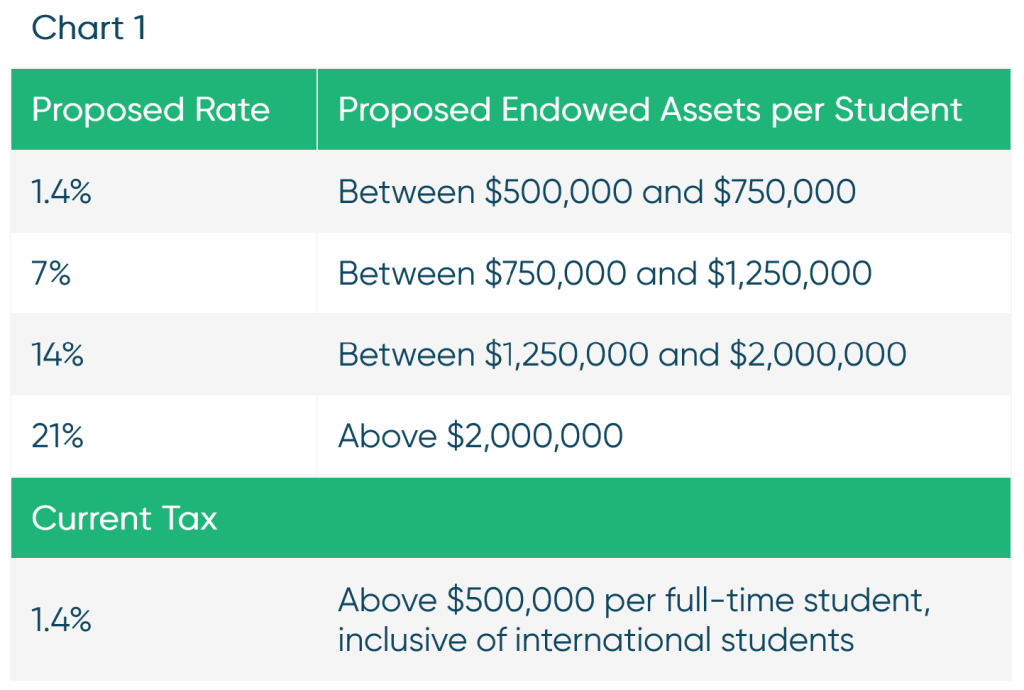
Endowment Tax Tier Determination
Source: https://www.politico.com/f/?id=00000196-c5d5-d69e-add7-dfdf2e210000.

The Joint Committee on Taxation estimates this will generate $6.69 billion over 10 years.4

Case Study: International Exclusion May Push UPenn into 14% Tier

The exclusion of international students in the student count for tier determination is important. The University of Pennsylvania had 29% international students enrolled in Fall 2024. Utilizing the total number of enrolled (or even just full-time students), Penn would be in the 7% tax tier. However, with the international students excluded, Penn is now in the 14% tax tier–double the tax of the lower tier it would have previously qualified for if its full student population was counted, and 10 times its current tax of 1.4%.
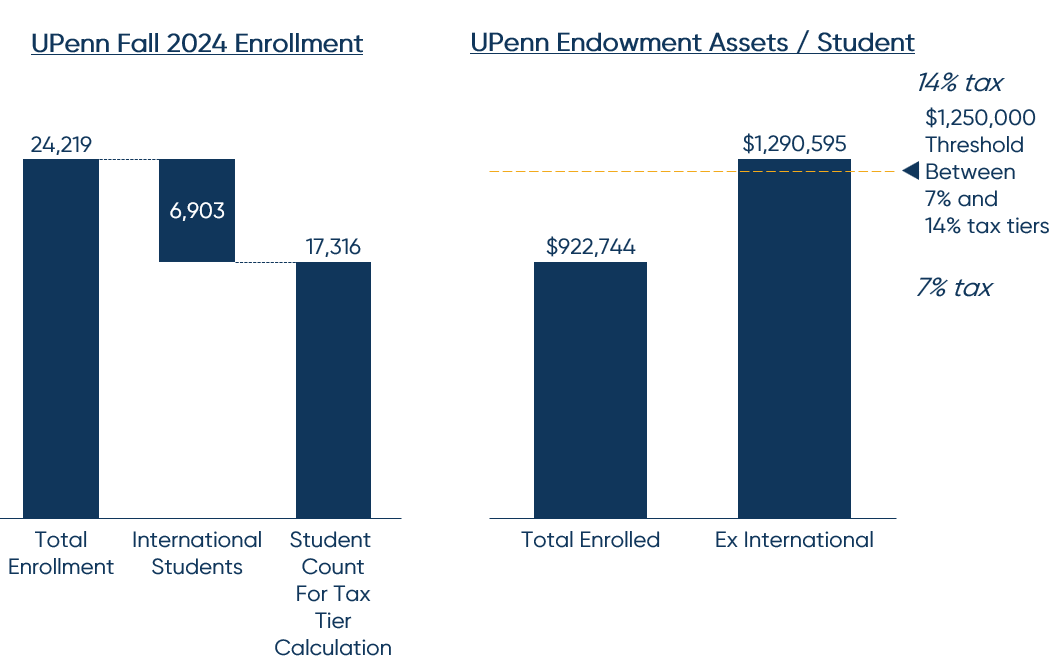
FY24% of Op Budget from Endowment
Source: FY2024 University of Pennsylvania Annual Report; University of Pennsylvania “About” website, pulled 5/18/2025. The tax excludes part-time students, which University of Pennsylvania had 4,890 in fall 2024, making it $100,000 below the 14% tier.

Private Foundation Tax to be Tiered

This proposal increases the amount of tax certain foundations will pay in the future. Today all foundations pay a 1.39% tax.

  • Rate: Increases the 1.39% single-tier tax to four rate tiers with the highest rate set at 10%. A foundation will pay a single rate, based on its tier, on all net investment income.5
  • Tier Determination: the total foundation’s assets will determine what tier of tax an endowment will pay, not just investment assets. Total foundation assets include all assets, with no reduction for liabilities, and would also take into account assets of certain related organizations.
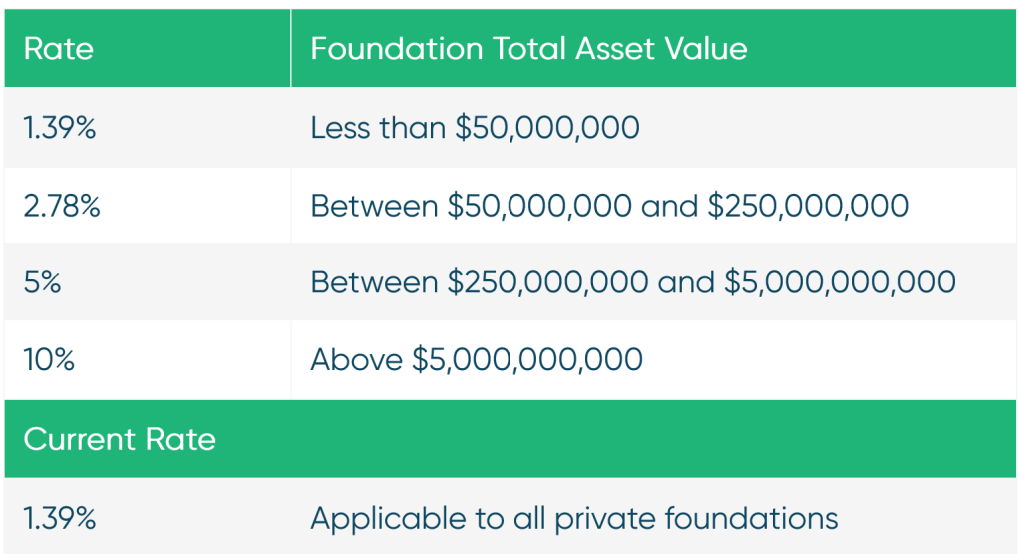
Tiered Private Foundation Tax Rate
Source: https://www.politico.com/f/?id=00000196-c5d5-d69e-add7-dfdf2e210000.

The Joint Committee on Taxation estimates this will generate $15.88 billion over 10 years.6

Summary

For institutions, a new or increased tax, depending on the tier, has varying level of impact–from small (1.4%/1.39%) to significant (21% for endowments or 10% for foundations). Impacted institutions may need to consider how the reduction in invested assets, and thus reduced spending, may necessitate changes to the budget or investment pool. TIFF has discussed the potential impact and implications of the endowment tax previously, summary of which is:

  • Budget Implications: Institutions may need to reconsider their budget if suitable long-term replacements are not feasible for lost budgetary support from the investment pool.
  • Investment Implications: If an institution is in a high enough tax tier, it may need to consider changing its approach, potentially increasing its risk tolerance or shifting asset allocation to incur less investment income.

These proposed changes and the associated implications create a challenging time for the nonprofit community. TIFF remains committed to helping organizations determine the right investment strategy for their unique situation.

The materials are being provided for informational purposes only and constitute neither an offer to sell nor a solicitation of an offer to buy securities. These materials also do not constitute an offer or advertisement of TIFF’s investment advisory services or investment, legal or tax advice. Opinions expressed herein are those of TIFF and are not a recommendation to buy or sell any securities.

These materials may contain forward-looking statements relating to future events. In some cases, you can identify forward-looking statements by terminology such as “may,” “will,” “should,” “expect,” “plan,” “intend,” “anticipate,” “believe,” “estimate,” “predict,” “potential,” or “continue,” the negative of such terms or other comparable terminology. Although TIFF believes the expectations reflected in the forward-looking statements are reasonable, future results cannot be guaranteed.


‘Tipping Point’: Endowments May Sell PE Stakes Amid Liquidity Crunch

Anne Duggan, Managing Director, Client CIO Group at TIFF, notes that the potential sales of private equity stakes by Ivy League schools are likely driven by private equity underperformance, portfolio clean-up, and federal policy pressures, which are creating substantial liquidity challenges. She emphasizes that while larger endowments might need to shift portfolios or cut budgets, smaller endowments, with more investments in public markets, may adopt a “wait and see” approach.

Read the full article

Disclaimer: To access this article, a subscription may be necessary. Please note that TIFF does not possess the rights to distribute this content.

The materials are being provided for informational purposes only and constitute neither an offer to sell nor a solicitation of an offer to buy securities. These materials also do not constitute an offer or advertisement of TIFF’s investment advisory services or investment, legal or tax advice. Opinions expressed herein are those of TIFF and are not a recommendation to buy or sell any securities.

These materials may contain forward-looking statements relating to future events. In some cases, you can identify forward-looking statements by terminology such as “may,” “will,” “should,” “expect,” “plan,” “intend,” “anticipate,” “believe,” “estimate,” “predict,” “potential,” or “continue,” the negative of such terms or other comparable terminology. Although TIFF believes the expectations reflected in the forward-looking statements are reasonable, future results cannot be guaranteed.

Johns Hopkins: How Restricted Endowment Funds Affect Budget Flexibility

Restricted Funds – Why the Endowment Can’t Save a Budget – Johns Hopkins University Case Study

Following federal funding cuts, Johns Hopkins University (“JHU”) announced that they will repurpose a portion of its existing spend from their $13.1B endowment to help fill their c. $1B research funding gap. The cuts hit JHU particularly hard, as JHU is the largest recipient of NIH (National Institute of Health) grants, and over 50% of its revenue comes from federal funding.1 JHU has already lost over 100 federal research grants and cut 2,200 jobs following the USAID cuts.2

Why can’t JHU take more out of the endowment to support the gap? Why can it only repurpose existing funds?

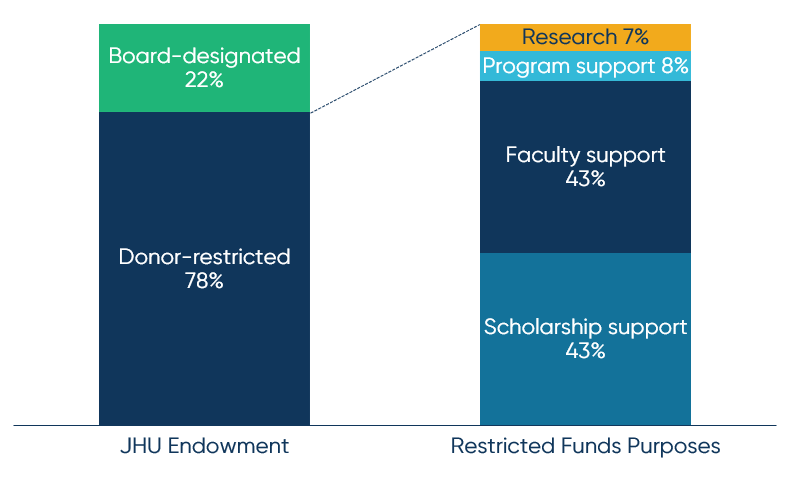
JHU’s endowment, which has 78% of its AUM in donor-restricted funds, highlights the nuances of endowments that add a layer of complexity when trying to solve budget issues.

What are restricted funds?

Endowments are often made up of many underlying gifts. A portion of these gifts are unrestricted, meaning the institution can use those funds for any purpose it sees fit. However, there are also restricted funds, which occurs when the donor provided stipulations about how those funds can be spent. Examples could include financial aid for specific criteria (e.g., geographic focus, major focus), faculty support (e.g., endowed chairs), specific school funding (e.g., library books only), among a number of other purposes. An institution can decline any gift with overly stringent stipulations. These stipulations are legally binding and therefore not easily changed.

To change a restricted fund stipulation, institutions either need the original donor to change the legal document, or, if the original donor is now deceased, the institution can petition its state’s Attorney General to change it. A revision is likely a broader application of the original intent, not to unrestricted purpose.

Why can’t restricted funds be used to fill any funding gap?

Restricted funds can only be used for their designated purpose, meaning the endowment is not a carte blanche savings account for the institution. Only unrestricted funds can be used for these emergency purposes, reducing the funds available for special appropriations.

Johns Hopkins University: A Case Study on Restricted Funds

JHU has a $13.1B endowment, 78% ($10.2B) of which represents restricted funds. JHU notes that its endowment is comprised of approximately 4,700 individual funds, including both restricted and unrestricted funds. JHU’s endowment supported 6% of its budget in FY24, while federal contracts represented more than 50%. JHU withdrew 4.2% from its endowment in FY24.3

JHU’s high allocation to restricted funds provides the university with less flexibility in how the organization can use its endowment. Of those restricted funds, only 7% are designated for research and the stipulations may be too narrow for funding cut-related projects.  To entirely replace lost funding, JHU would be required to use one-third of its unrestricted funds ($2.9B). Covering the entire funding cuts would deplete all of the unrestricted funds in 3 years. Because endowed funds must exist in perpetuity per the Uniform Prudent Management of Institutional Funds Act (UPMIFA), this solution is not feasible, which is why JHU ultimately repurposed the existing endowment payout instead of taking more from the endowment.

Johns Hopkins University Endowment Details

John Hopkins University Endowment Details
Source: FY24 Johns Hopkins University Annual Report.

The Baltimore Banner reported on JHU’s statement on the issue of restricted funds: “It’s a common misconception that universities can simply “use the endowment” in moments like this. The reality is that most of our endowment is made up of legally restricted funds designated by donors for specific purposes. The principal of the endowment must legally be preserved in perpetuity — to support Johns Hopkins’ mission now and for future generations — and cannot be drawn down like a reserve fund. That said, we are using flexible resources — some of which are tied to endowment earnings — to help sustain critical research in this moment of uncertainty.”4

Conclusion

Higher education institutions face many challenges today with federal funding cuts. The nuances of endowments make it hard for institutions to utilize just the endowment to solve budget issues. In addition to the “in perpetuity” requirement for endowed funds (meaning taking out too much continuously will ultimately drain the endowment), the restricted vs. unrestricted funds dynamic is another factor institutions contend with.

For its clients, TIFF is focused on ensuring each client’s Strategic Asset Allocation, in particular, liquidity, is tailored to the unique circumstances of each institution. Understanding the structure of your endowed funds, and broader institution’s financial circumstances, can help any institution weather a challenging time such as we are in currently.

The materials are being provided for informational purposes only and constitute neither an offer to sell nor a solicitation of an offer to buy securities. These materials also do not constitute an offer or advertisement of TIFF’s investment advisory services or investment, legal or tax advice. Opinions expressed herein are those of TIFF and are not a recommendation to buy or sell any securities.

These materials may contain forward-looking statements relating to future events. In some cases, you can identify forward-looking statements by terminology such as “may,” “will,” “should,” “expect,” “plan,” “intend,” “anticipate,” “believe,” “estimate,” “predict,” “potential,” or “continue,” the negative of such terms or other comparable terminology. Although TIFF believes the expectations reflected in the forward-looking statements are reasonable, future results cannot be guaranteed.
Footnotes

  1. FY24 Johns Hopkins University Annual Report, inclusive of grants, contracts, and similar agreements and Applied Physics Laboratory contract revenues.

  2. https://www.thebaltimorebanner.com/education/higher-education/johns-hopkins-federal-research-UMTJ2XGVFBB6JB4ZG3RB2LSXLU/

  3. FY24 Johns Hopkins University Annual Report.

  4. https://www.thebaltimorebanner.com/education/higher-education/johns-hopkins-federal-research-UMTJ2XGVFBB6JB4ZG3RB2LSXLU/

Fundraising in Federal Funding Uncertainty

Nonprofits in the United States are facing unprecedented financial hardship. Swift federal policy changes have left organizations in a state of urgency and confusion as the government grants and contracts they have regularly relied on have been canceled or held in limbo. How does the changing policy landscape impact nonprofits’ ability to deliver their services? What can fundraisers do to ensure they can secure funding to continue to deliver their services?

How did we get here?

The federal government has used the nonprofit sector to provide services to address poverty and social issues since the Johnson administration. The sector has also seen tremendous growth over time, with the number of nonprofits increasing by 60% between 1998-2023. The government’s investment in the sector is critical: as an Urban Institute report shows “[i]n every state, every congressional district, and more than 95% of counties in the United States, public charities receive government grants” which totals to $267B.  As the Trump administration moves away from providing government grants to nonprofits, fundraisers are left with a huge gap to fill.

How can fundraisers address this moment?

While the sheer size of this funding gap is daunting, there are strategies leaders can take to educate their teams, engage existing supporters, and secure funding to maintain services:

  • Stay up to date: Organizations like the National Council of Nonprofits regularly provide updates and resources on policy changes that impact nonprofits. By finding similar resources for your industry, fundraisers can keep abreast of changes without overwhelming themselves.
  • Mobilize your donor base: If organizations are transparent with supporters about the financial risk they face, donors may step up to invest in your organization in new and meaningful ways. Consider how you can solicit your individual donors differently to fund programs or build up your corporate partnerships.
  • Connect with fellow fundraisers: No individual or organization should address uncertainty in isolation. Find avenues to connect with professional development groups and attend conferences to both learn from and support your peers.
  • Access emergency funding: Foundations and philanthropists are providing emergency funding to nonprofits during this turbulent time. The Chronicle of Philanthropy is regularly updating its website with information on the different funds available to organizations

To learn more about how you can help your organization navigate financial uncertainty, register for the webinar Fundraising in a Time of Uncertainty on Wednesday, May 7, 2025, from 10-11AM ET. This webinar will feature Jessica Portis, Chief Client Officer at TIFF in conversation with Ebonie Johnson Cooper, Faculty Director, Do Good Institute at the University of Maryland’s School of Public Policy and Martin Sanders, Adjunct Faculty at the University of Maryland’s School of Public Policy.

The materials are being provided for informational purposes only and constitute neither an offer to sell nor a solicitation of an offer to buy securities. These materials also do not constitute an offer or advertisement of TIFF’s investment advisory services or investment, legal or tax advice. Opinions expressed herein are those of TIFF and are not a recommendation to buy or sell any securities.

These materials may contain forward-looking statements relating to future events. In some cases, you can identify forward-looking statements by terminology such as “may,” “will,” “should,” “expect,” “plan,” “intend,” “anticipate,” “believe,” “estimate,” “predict,” “potential,” or “continue,” the negative of such terms or other comparable terminology. Although TIFF believes the expectations reflected in the forward-looking statements are reasonable, future results cannot be guaranteed.

Federal Threats Cause Endowments to Reconsider Investment Strategies

Anne Duggan, CAIA, Managing Director of TIFF Investment Management’s Client CIO Group, recently shared insights with PEI Buyouts on how endowments are adjusting to new federal policies. She discussed the challenge of balancing the need for financial support with the goal of maintaining long-term endowment growth, and how investment strategies are being reconsidered to meet these goals.

Read the full article
Disclaimer: To access this article, a subscription may be necessary. Please note that TIFF does not possess the rights to distribute this content.

The materials are being provided for informational purposes only and constitute neither an offer to sell nor a solicitation of an offer to buy securities. These materials also do not constitute an offer or advertisement of TIFF’s investment advisory services or investment, legal or tax advice. Opinions expressed herein are those of TIFF and are not a recommendation to buy or sell any securities.

These materials may contain forward-looking statements relating to future events. In some cases, you can identify forward-looking statements by terminology such as “may,” “will,” “should,” “expect,” “plan,” “intend,” “anticipate,” “believe,” “estimate,” “predict,” “potential,” or “continue,” the negative of such terms or other comparable terminology. Although TIFF believes the expectations reflected in the forward-looking statements are reasonable, future results cannot be guaranteed.