Endowment Tax – Part II: Impact on the Endowment

Executive Summary

  • Our last article focused on endowment tax proposals and how they may impact educational institutions directly.
  • This article looks at the specific impact on the endowment portfolio.
  • Today’s 1.4% tax is expected to cause a reduction of 5-15 basis points in net returns, according to TIFF estimates. A tax increase to 10% or above starts to be meaningful.
  • This tax introduces an issue where institutions may no longer be able to maintain inflation-adjusted purchasing power after spending and tax with their current target returns.
  • If a 10%+ rate is enacted, institutions will face a delicate balance between reconsidering asset allocation to reduce tax burden, potentially increasing risk to increase expected return, or decrease spending.
  • TIFF will continue focus on the topic as new information becomes available.

As a Reminder: Summary of Proposals

In our last article, TIFF outlined the various endowment tax proposals. Below is a summary:
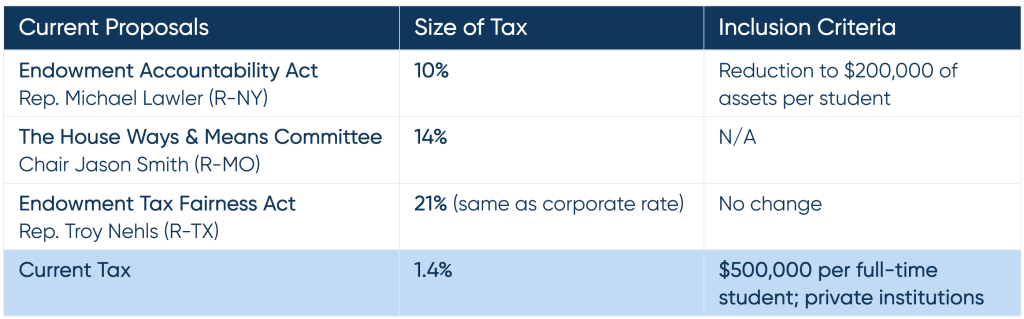
Summary of Proposals

Endowment Tax Impact on Portfolio Returns

It is important to remember this tax is levied on net investment income, not total assets, so any headline tax rate is diluted. “Net investment income” includes everything from capital gains to dividends (investment income passively obtained), net of eligible deductions such as advisory and brokerage fees.[i], [ii] This tax is charged on realized gains/income, meaning that even in a negative performance year, the endowment could incur a tax liability.

TIFF has estimated the impact of the current tax (1.4%) and various proposals on after-tax net returns for endowment style portfolios.[iii]

  • The current tax has minimal impact on after-tax net returns; TIFF estimates this causes a reduction of 5-15 basis points of net returns.
  • A tax increase to 10% or above starts to be meaningful.
  • TIFF has added a “plausible compromise” scenario of a 5% tax, which is noticeable, though not dramatic, at an estimated 20-40 basis points drag per year.

Estimated Excise Tax Impact on Net Returns

Estimated Excise Tax Impact on Net Returns
Source: TIFF internal analysis.

Potential Implications for the Endowment

At a 1.4% tax, institutions are unlikely to adjust their portfolios. However, a tax rate of 10% or higher would likely prompt institutions to explore options to manage the tax impact. There is no single solution to the endowment tax. Addressing the implications of the endowment tax will require a multi-dimensional approach, balancing reconsidering the spend rate, increasing the expected return slightly, and tweaking the investment strategy to reduce the annual tax burden–all while trying to maintain support for the institution and best practices of portfolio construction.

This tax introduces an issue where institutions may no longer be able to maintain inflation-adjusted purchasing power after spending and tax, with their current target returns. The graph below shows an illustrative scenario for a hypothetical educational institution with a 4.5% spend rate. Without tax, their target return is likely around 7.5%. However, the introduction of an endowment tax reduces the net returns available for compounding. TIFF has outlined three potential solutions institutions may look at individually, or in concert, to address this issue.

Hypothetical Target Return Requirement Build-up
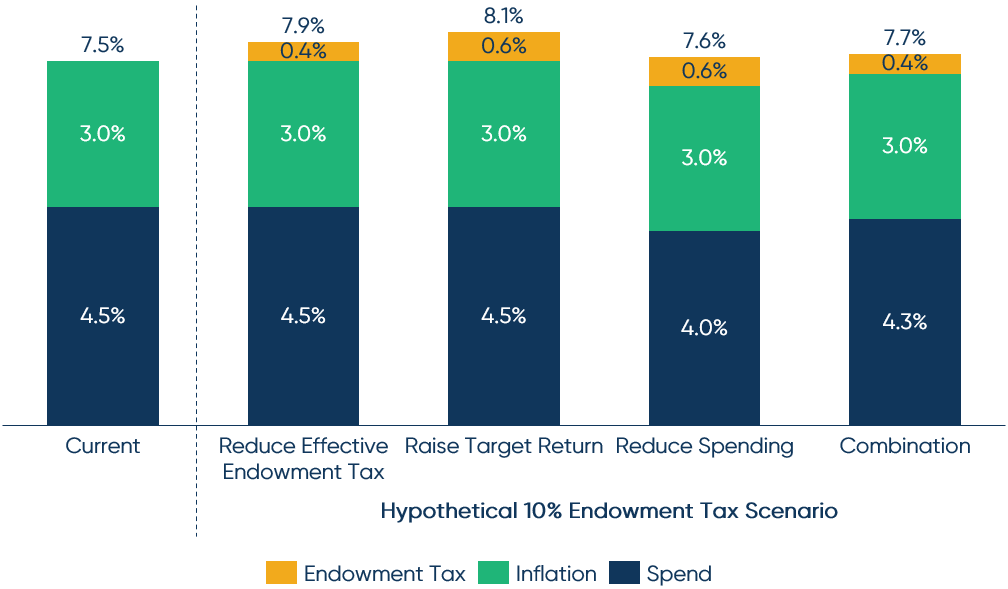
Hypothetical Target Return Requirement Build-up

  • Reduce tax burden by revising asset allocation: Tax is on net investment income, which mean it taxes all realized gains in a year equally. Altering the types of investments the endowment is invested in may help to reduce the tax burden. Two broad approaches are:
    • Increase allocation to assets that defer realizations (e.g., long-hold equities, private equity).
    • Decrease allocation to assets that have high annual income/gains (e.g., fixed income, high-turnover hedge funds, income-focused core real estate).
  • Increase target return via increased risk level to (partially) offset the tax: With no change in spend, a tax will increase one’s target return requirements (CPI+spend rate+annual tax rate). However, a balance must be struck between increasing the target return, and therefore overall risk, and decrease in spend rate. This may not be feasible for many institutions who already are at their risk tolerance.
  • Non-Endowment Option: Decrease the spend to offset the tax: While a difficult conversation depending on how large the tax is, discussing the spend rate and likelihood of hitting an institution’s long-term inflation-adjusted real rates of return post-spend will be important.

Conclusion

This topic is still emerging with various proposals at play. TIFF remains engaged and focused on the topic, helping our clients understand the implications. If your institution believes it might be at risk for inclusion, please reach out to your TIFF team for further discussion.

The materials are being provided for informational purposes only and constitute neither an offer to sell nor a solicitation of an offer to buy securities. These materials also do not constitute an offer or advertisement of TIFF’s investment advisory services or investment, legal or tax advice. Opinions expressed herein are those of TIFF and are not a recommendation to buy or sell any securities.

These materials may contain forward-looking statements relating to future events. In some cases, you can identify forward-looking statements by terminology such as “may,” “will,” “should,” “expect,” “plan,” “intend,” “anticipate,” “believe,” “estimate,” “predict,” “potential,” or “continue,” the negative of such terms or other comparable terminology. Although TIFF believes the expectations reflected in the forward-looking statements are reasonable, future results cannot be guaranteed.

[i] https://www.irs.gov/newsroom/irs-issues-guidance-on-the-tax-on-the-net-investment-income-of-certain-private-colleges-and-universities

[ii] https://www.irs.gov/newsroom/questions-and-answers-on-the-net-investment-income-tax

[iii] Endowment style portfolios are defined as portfolios with high allocations to alternatives, including hedge funds, private equity and venture capital.


The Impact of Proposed Endowment Tax Changes

Executive Summary

  • Congress is currently discussing multiple endowment tax proposals.
  • While most colleges today pay no federal tax as nonprofit institutions, the 2017 Tax Cuts and Jobs Act (TCJA) introduced a 1.4% excise tax on the wealthiest of endowments. Fifty-six institutions paid that tax in 2023.[i]
  • The new proposals look to (1) increase the existing excise tax from 1.4% to 21%[ii] or above, and (2) expand the applicability of the tax to include a broader range of institutions by reducing the endowment assets per student criteria.
  • While there are many opponents, certain groups believe some version of these proposals will get passed.
  • The greatest impact on affected institutions would be the reduction of funds available to the institutions to support their mission, whether financial aid or general operating budget.
  • Higher endowment taxes will also raise the required rate of return for endowments. TIFF is available to assist clients in navigating these challenges and understanding the potential implications for their portfolios.

The Impact of Proposed Endowment Tax Changes

The discussion surrounding the taxation of college endowments is intensifying as legislators evaluate potential amendments to the existing tax regulations. The most well-known proposed changes have centered around increasing the rate at which endowments are taxed and broadening the group of colleges and universities that are impacted. If enacted, these proposals could materially change the financial strategies of these institutions.

Understanding the Current Excise Tax

Historically, colleges and universities operated as tax-exempt nonprofits, with no taxes paid on donations or investment earnings. However, during the first Trump administration, the Tax Cuts and Jobs Act (TCJA) of 2017 introduced an endowment tax. The existing tax is as follows:

  • Tax: 1.4% excise tax on net investment income.
  • Criteria for inclusion: (1) private institutions with (2) at least 500 tuition-paying students and (3) endowment assets exceeding $500,000 per full-time student.

The rationale behind the tax was to generate additional revenue and address concerns that educational institutions were not contributing enough to public finances. The tax aimed to encourage colleges and universities to use their endowment funds to reduce tuition costs and increase student aid.

The tax affects only the wealthiest of private colleges and universities. In 2023, 56 universities paid about $380 million in endowment tax, up from about $68 million in 2021 from 33 institutions1. The tax threshold for qualifying for taxation is not adjusted for inflation, resulting in an increasing number of schools becoming liable for the tax over time. As college and university endowments continue to grow, the associated tax revenue will grow as well.

Proposed Changes to the Endowment Tax Law

The Trump administration’s tax proposals for 2025 focus on extending and potentially expanding some of the provisions of the TCJA of 2017, which are set to expire at the end of this calendar year. While the endowment excise tax is permanent, it has garnered attention due to its significant revenue-generating potential and the current federal budget deficit.

Proposed adjustments to the endowment tax focus on two potential changes:

  • Increasing the excise tax rate: Proposals suggest raising the tax rate from 1.4% to 10%, 14%, 21% or potentially even higher.
  • Expand the number of colleges and universities subject to the tax: Proposals range from no change to lowering the criteria to $200,000 of assets per student. Rep. Michael Lawler (R-NY-17)’s Endowment Accountability Act proposes the reduction to $200,000 of assets per student[iii] while Rep. Troy E. Nehls (R-TX-22)’s Endowment Tax Fairness Act does not include an expansion.

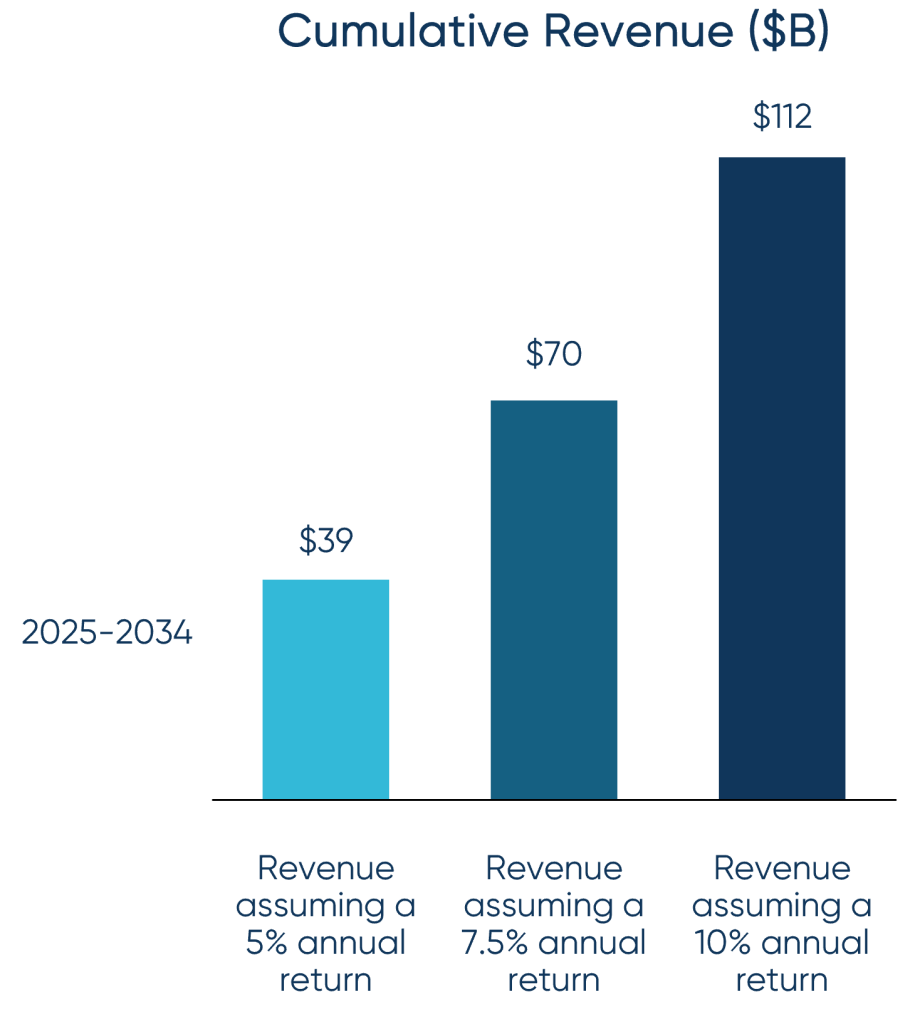
As with TCJA of 2017, the objective is to raise federal revenue further to reduce the national deficit.[iv] Taxfoundation.org estimates that increasing the endowment tax from 1.4% to 21%, with a 7.5% average annual endowment return, would generate about $69.8 billion in extra revenue over 10 years.

Taxing Endowments: Revenue Analysis of an Endowment Tax

Source: Taxfoundation.org

How Likely Is this Expanded Endowment Tax to Pass?

These proposals are still in the early stages, and there are many opponents. Certain groups believe changes are likely due to the administration’s focus on fair resource distribution and raising federal revenue. The first Trump administration passed the first-ever endowment tax, albeit small, and the second Trump administration has struck an action-oriented tone. It remains to be seen what is approved, if anything, and in what form.

Potential Implications of the Proposed Tax Law Changes on Impacted Endowments

For those impacted, the proposed increase in the endowment tax would undoubtedly reduce the amount of endowment funds available to support the institution’s mission. Colleges and universities are preparing for possible tax changes and trying to understand how these challenges might affect the higher education landscape more broadly.

School business offices are thinking about the impact higher taxes will have on:

  • College affordability: Higher taxes could reduce funds for tuition assistance and scholarships, making college less affordable for some students.
  • Budget and spending: Tuition alone doesn’t cover education costs, so institutions rely on endowments and donors to fill the gap. Reduced support from the endowment could force cuts to student services, infrastructure, and other areas.
  • Research funding: Increased taxes could lead universities to scale back research initiatives, affecting advancements in science, technology, and medicine.
  • Charitable giving: Higher taxes might deter future donations, as donors may not want part of their gift to go toward taxes.

The long-term effects of taxing endowments are a topic of debate. However, the bottom line is that colleges and universities will need to generate returns to offset any tax burden. Given that most colleges and universities pursue an investment return of inflation plus spend (historically around 8% and not always easy to achieve), compensating for an increased tax burden will lead to changes in investment strategy.

Conclusion

Legislators are closely examining the nonprofit sector to generate funding for other projects and ensure that wealthy educational institutions contribute more to public finances. Forecasting the future of the tax landscape is difficult and as a result, colleges and universities are beginning to prepare for the unknown. Those responsible for overseeing the endowment are engaging in several activities to prepare:

  • Maintaining communication with the college and university’s tax and legal counsel to stay informed about developments in tax law.
  • Forming advocacy consortiums to ensure their collective point of view is heard around the role and benefits of endowments.
  • Discussing with the business office the implications of possible tax law changes on the college and university’s budget and spending.
  • Exploring tax-efficient investment strategies that could help mitigate a larger potential tax burden.

While the direction of tax reform is uncertain, TIFF is prepared to assist higher education institutions in meeting their financial needs. For more information, please contact info@tiff.org.

The materials are being provided for informational purposes only and constitute neither an offer to sell nor a solicitation of an offer to buy securities. These materials also do not constitute an offer or advertisement of TIFF’s investment advisory services or investment, legal or tax advice. Opinions expressed herein are those of TIFF and are not a recommendation to buy or sell any securities.

These materials may contain forward-looking statements relating to future events. In some cases, you can identify forward-looking statements by terminology such as “may,” “will,” “should,” “expect,” “plan,” “intend,” “anticipate,” “believe,” “estimate,” “predict,” “potential,” or “continue,” the negative of such terms or other comparable terminology. Although TIFF believes the expectations reflected in the forward-looking statements are reasonable, future results cannot be guaranteed.

[i] Endowments impacted under the current tax include Harvard University, Yale University, Princeton University, Stanford University, Massachusetts Institute of Technology (MIT), the University of Pennsylvania, Northwestern University, Washington University, Duke University, and Vanderbilt University per https://nehls.house.gov/media/press-releases/rep-troy-e-nehls-introduces-bill-hold-elite-university-endowments-accountable.

[ii] 21% is proposed in Rep. Troy Nehls (R-TX)’s Endowment Tax Fairness Act, which would match the federal corporate income tax rate. The House Ways & Means Committee’s Chair Jason Smith (R-MO) outlined a 14% rate. Rep. Michael Lawler (R-NY)’s Endowment Accountability Act proposes 10%.

[iii] https://lawler.house.gov/news/documentsingle.aspx?DocumentID=3716

[iv] Rep. Troy E. Nehls (R-TX-22)’s Endowment Tax Fairness Act states its objectives as “The revenue derived from the amendment made by this section shall be deposited in the general fund of the Treasury and shall be used to reduce the national deficit, to the extent thereof, and thereafter to reduce the national debt.”

Footnotes

  1. Source: “University Endowment Tax Receipts Rise Again,” Nonprofit Issues, accessed February 25, 2025, https://www.nonprofitissues.com/article/university-endowment-tax-receipts-rise-again.