
Overview of Trump’s Battle with Harvard

Introduction

The recent actions taken by the Trump Administration against Harvard University have sent shockwaves through the higher education community. With investigations into Antisemitic discrimination, demands for sweeping reforms, and threats to revoke tax-exempt status, the federal government is challenging the autonomy and operational frameworks of one of the nation’s most prestigious institutions. This brief article explores the unfolding situation, the positions of both Harvard and the federal government, and the broader implications for non-profit universities across the United States.

What is happening with Harvard and the Trump Administration

  • The Department of Education (DOE) sent 60 universities notice that they were under investigation for Antisemitic discrimination and harassment.1 It was noted federal funding would be revoked for those that don’t accept required steps to protect Jewish students.2 Columbia University was the first target, which currently negotiating with the federal government after $400M of funding was frozen.3
  • The Department of Education sent Harvard a list of refined requirements on April 11, which included eliminating diversity and inclusion programs and enacting merit-based hiring and admission reforms, banning masks on campus, and reducing power of faculty and administrators.4
  • Harvard responded on April 14 that it will not comply with the request, arguing that the changes requested by the government exceed its lawful authority and infringe on both the University’s independence and its constitutional rights.5 6
  • The Federal government has retaliated by blocking $2.2B in funding slated for Harvard.
  • The IRS investigation into revoking Harvard’s tax-exempt status7 and the Department of Homeland Security review of Harvard’s ability to enroll foreign students were announced this week.8
  • Non-profits face significant risks including a potential larger role of government at U.S. universities, potential loss of tax-exempt status, the financial impacts of losing Federal funding or revenue tied to foreign student enrollment, and becoming a tax-paying entities.

The Two Sides
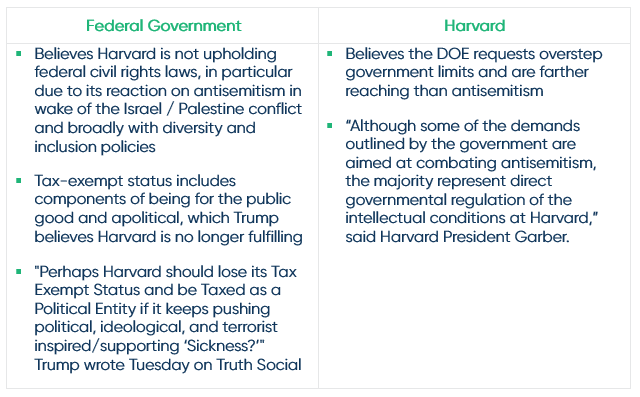
What is at Stake

The outcome, if in the Federal government’s favor, will change the rules of engagement for U.S. education and have long lasting impacts on U.S. higher education on the involvement and control.

Precedent for Loss of Tax-Exempt Status: This would set a precedent for U.S. higher education losing tax-exempt status if they do not align with views of being apolitical and for the public good. One would imagine those definitions are qualitative at times and any potential loss of status will be left to the courts.

Loss of Tax-Exempt Status Financial Impact: Harvard would become a for-profit entity, meaning the entire institution would now be subject to taxation. This would be broader taxation than its current endowment tax, which is restricted to endowment net investment income. Corporate taxes are charged at the entity level. In addition, Harvard would now be subject to state and local taxes.

Bloomberg estimated Harvard’s property taxes alone at $465M, with assessed property at $4 billion in Boston and $8.7 billion in Cambridge.9

Where are those taxes coming from?

  • Federal Corporate Rate: 21% on corporate profit
  • State Corporate Rate (MA): 8% on corporate profit
  • Local (Boston, Cambridge): As one of the largest land-owners in the area, Harvard would now be subject to property tax in Cambridge and Allston. For example, Cambridge charges corporations $11.52 per $1,000 of assessed property value.10

Other impacts would be donations are no longer tax-deductible, likely leading to a decline in funding through donations.

All of these would require a structural change in how Harvard is structured and thinks about its financials.

Conclusion

The conflict between Harvard and the Trump Administration highlights the risks nonprofit universities face from increased government influence. If the government wins, it could set a precedent affecting tax-exempt status, funding, and institutional independence. Nonprofits should stay informed and be prepared for changes in regulations and resulting impact on finances. The outcome could impact not only Harvard but also the broader higher education sector, requiring a reassessment of the balance between educational autonomy and government oversight.

The materials are being provided for informational purposes only and constitute neither an offer to sell nor a solicitation of an offer to buy securities. These materials also do not constitute an offer or advertisement of TIFF’s investment advisory services or investment, legal or tax advice. Opinions expressed herein are those of TIFF and are not a recommendation to buy or sell any securities.

These materials may contain forward-looking statements relating to future events. In some cases, you can identify forward-looking statements by terminology such as “may,” “will,” “should,” “expect,” “plan,” “intend,” “anticipate,” “believe,” “estimate,” “predict,” “potential,” or “continue,” the negative of such terms or other comparable terminology. Although TIFF believes the expectations reflected in the forward-looking statements are reasonable, future results cannot be guaranteed.

Federal Threats Cause Endowments to Reconsider Investment Strategies

Anne Duggan, CAIA, Managing Director of TIFF Investment Management’s Client CIO Group, recently shared insights with PEI Buyouts on how endowments are adjusting to new federal policies. She discussed the challenge of balancing the need for financial support with the goal of maintaining long-term endowment growth, and how investment strategies are being reconsidered to meet these goals.

Read the full article
Disclaimer: To access this article, a subscription may be necessary. Please note that TIFF does not possess the rights to distribute this content.

The materials are being provided for informational purposes only and constitute neither an offer to sell nor a solicitation of an offer to buy securities. These materials also do not constitute an offer or advertisement of TIFF’s investment advisory services or investment, legal or tax advice. Opinions expressed herein are those of TIFF and are not a recommendation to buy or sell any securities.

These materials may contain forward-looking statements relating to future events. In some cases, you can identify forward-looking statements by terminology such as “may,” “will,” “should,” “expect,” “plan,” “intend,” “anticipate,” “believe,” “estimate,” “predict,” “potential,” or “continue,” the negative of such terms or other comparable terminology. Although TIFF believes the expectations reflected in the forward-looking statements are reasonable, future results cannot be guaranteed.

Case Study: A Successful Transition to an OCIO Provider: McDonogh School and TIFF Investment Management

Overview

In 2024, McDonogh School, a PK-12 independent school in Owings Mills, Maryland, successfully transitioned its endowment management to TIFF Investment Management (TIFF), an Outsourced Chief Investment Officer (OCIO). The goal of the transition was to better align the endowment portfolio with McDonogh’s investment objectives and support the school’s mission to provide life-altering educational experiences that inspire personal and intellectual growth.

“A streamlined transition process helped us facilitate a smooth shift to TIFF, strengthening our long-term strategy and ensuring financial and risk management considerations were carefully addressed,” noted Sherri Voelkel, Chief Financial Officer at McDonogh School.

Challenge

Transitioning to an OCIO is a multi-faceted endeavor requiring the well-orchestrated movement of potentially millions of dollars of investments, agreement on the strategic vision for the portfolio, and completion of many legal and administrative documents. Various groups are involved, increasing the need for coordination.

Solution

Over the course of the second half of 2024, McDonogh and TIFF successfully completed the transition utilizing project management best practices with adherence to endowment management best practices throughout the process. A summary is below:

Project Management Best Practices

1. Identifying Key Stakeholders and Their Responsibilities

The success of any OCIO transition hinges on assembling the right stakeholders in the process and establishing their responsibilities at the beginning stages of the transition. Key stakeholders and their responsibilities in the transition include:

  • School Leadership: Partner with the OCIO on the transition plan, executing operational and legal tasks while providing input on the school’s financial circumstances.
  • Board-Level Investment Committee: Provide guidance on and approval of the SAA and the IPS, as well as review key decisions regarding the investment strategy.
  • Board-Level Finance Committee: Provide additional input on the school’s financial circumstances and approve the SAA and IPS.
  • The Board: Provide final approval of the IPS and other governing documents.
  • OCIO (TIFF): Lead and manage the transition process, designing and executing the plan to ensure alignment with the school’s financial goals, risk tolerance, and return objectives. Also, provide education and clarification whenever needed.
  • Previous Advisor (if relevant): Serve as the counterparty in transitioning assets.

The key stakeholders for McDonogh are aligned with its governance structure; however, it’s important to note that each school may have its own structure, which could impact the stakeholders involved.

2. Creating the Transition Plan and Timeline

During the transition, a well-defined project framework and timeline are crucial to establish key actions items, deadlines, and responsibilities.

  • Transition Date and Interim Check Points: A specific date or timeframe to transition the investment portfolio provides key stakeholders a unified goal to work toward, along with interim checkpoints to ensure the process remains on track.
  • Checklists: Using checklists ensures that action items and deadlines are tracked, holding key stakeholders accountable.

3. Clear, Transparent, and Frequent Communication

Effective communication is essential to the success of a transition, ensuring transparency and alignment among key stakeholders at each stage. The project lead should establish communication protocols and regular check-ins early in the transition process to facilitate important discussions with stakeholders.

  • Project Management (OCIO and Staff – Weekly): Prioritize the time needed for check-ins to cover operational tasks, timelines, and any roadblocks.
  • Strategic (OCIO, Investment Committee and Staff – two or three meetings): Schedule two or three Investment Committee meetings to discuss and make decisions on asset allocation, IPS, and other key investment and governance topics. There will also likely be intermittent discussions with the Investment Committee Chairs and/or school leaders in preparation for the transition.

Key Action Items in the Transition Stage

1. Conducting a Strategic Asset Allocation Review

A critical part of the transition is ensuring the endowment portfolio aligns with long-term financial goals and investment return objectives through the agreement on the SAA:

  • Required Target Return: How will this portfolio maintain inflation-adjusted value after spending?
  • Risk Tolerance: What is the school’s tolerance, both the Investment Committee and the school’s financial standing, for risk?
  • Liquidity Requirements: What is the school’s liquidity profile (e.g., spend, debt, emergency)?

The OCIO should also evaluate organizational factors, including:

  • Endowment Dependence: Reliance on the endowment draw to meet the annual budget
  • Operating Profile Stability: Stability assessment financials

SAA reviews help assess various options and trade-offs between different asset allocations, helping the stakeholders to make informed decisions that best align with the school’s investment return objectives and financial circumstances.

Voelkel notes, “McDonogh’s endowment represents our commitment to balancing exceptional educational experiences with responsible financial stewardship. The partnership with TIFF has enhanced our ability to fulfill this vital balance for current and future generations.”

2. Update Governance Documents

Internal documents, policies, and governance structures need to be revised to align with the new investment strategy and governance shift to discretionary management. The most pivotal document is the IPS, which outlines the school’s investment objectives, asset allocation, spending policy, and risk management guidelines. McDonogh transitioned to a discretionary OCIO relationship with TIFF, featuring a portfolio including previously underutilized investment strategies. In collaboration, TIFF and McDonogh revised the IPS accordingly, which required approval from the Board-Level Investment and Finance Committees as well as the full Board.

3. Legal Documentation and Other Technical Items

There will be an influx of different agreements and documents that will need to be reviewed and agreed upon by key parties. These include:

  • The Investment Management Agreement (IMA)
  • “Know Your Client” / Anti-Money Laundering review
  • Power of Attorney (POA)
  • New fund subscription documents and account opening for brokerage firm(s)

It is prudent to include legal counsel to review and, if appropriate, comment on all new agreements.

4. Executing the Transition of Portfolio Assets

The final step is moving the assets to the new provider and implementing the agreed-upon portfolio allocation. TIFF provided McDonogh with guidance on the complicated concert of implementing a new strategy while adhering to a few key principles:

  • Maintaining market exposure
  • Timely processes and coordination of cash movements
  • Clear timeline and dates of any redemptions and new subscriptions/investments

Conclusion

Successfully transitioning endowment management to an OCIO provider requires a strategic and collaborative approach. The process that TIFF and McDonogh executed ensured a seamless transition and enabled all stakeholders to have input into strategic decisions along the way.

The materials are being provided for informational purposes only and constitute neither an offer to sell nor a solicitation of an offer to buy securities. These materials also do not constitute an offer or advertisement of TIFF’s investment advisory services or investment, legal or tax advice. Opinions expressed herein are those of TIFF and are not a recommendation to buy or sell any securities.

These materials may contain forward-looking statements relating to future events. In some cases, you can identify forward-looking statements by terminology such as “may,” “will,” “should,” “expect,” “plan,” “intend,” “anticipate,” “believe,” “estimate,” “predict,” “potential,” or “continue,” the negative of such terms or other comparable terminology. Although TIFF believes the expectations reflected in the forward-looking statements are reasonable, future results cannot be guaranteed.